Festivals have played an important part in Nepali life and culture for centuries, and it seems like almost every day there is a celebration happening somewhere in the country. These can range from small-scale local festivals held by one of the country’s many tribes and ethnic groups, right up to nationwide Buddhist and Hindu celebrations, full of colour and music.
If you’re lucky enough to be in Nepal at the right time to experience these popular Nepalese festivals, it can add a truly unique experience to your vacation. 2026-2027 promises to be a big time for Nepali festivals once more!
Here is our list of the major festivals of Nepal coming up in 2026/27, as well as a little information about the most significant events in the calendar.
NOTE: Nepal follows the lunar calendar, meaning that the Western calendar dates for these festivals are slightly different each year.
Quick Links
Lhosar (2026 – January 19)
Lhosar is widely celebrated by Nepalese ethnic groups who trace their heritage to Tibet – namely the Gurung, Tamang, and Sherpa people. Lhosar is the first day of the new year, and each community celebrates the festival in its own way. Traditional dress is worn by young and old, and festivities are held across the country in cities and more remote regions.
Maha Shivaratri (2026 – February 15)
‘Shivaratri’ literally means the ‘night of Lord Shiva’, and on this day, devout Hindus bathe early in the morning and then fast before visiting Shiva temples for worship. The best place to witness the festival is at Pashupatinath temple in Kathmandu, where thousands of Sadhus (Hindu holy men) gather to smoke marijuana and hashish, considered dear to Lord Shiva. People also drink Bhang, a drink made by mixing ground nuts, spices, herbs, and extracts of marijuana into milk.
Basant Panchami (2026 – February 23)
Devotees worship the Hindu goddess Saraswati, the goddess of knowledge and creator of arts, education, and music. Celebrated by both Hindus and Sikhs across Nepal and India, people often dress in yellow on this day, and kite-flying is also common. Basant Panchami also marks the end of winter and the beginning of the spring season in Nepal.
Holi (2026 – March 2)
Perhaps the best-known festival on this list, Holi is a crazily colourful and playful event held over 2 days. It is celebrated in Kathmandu and the hill regions on one day and in the Terai region on the next day. People smear coloured powders on their friends, relatives, and family members, as well as take part in giant water fights using coloured water and water balloons.
There are a few more vibrant and photogenic festivals in the world… but be careful to try to keep your camera and valuables dry!
Ghode Jatra is a particularly important Nepali festival in the Kathmandu Valley and is celebrated to ward off the demonic Gurumapa. It is said the soul of the demon still lives underground at Tundikhel. To prevent him from rising again, a horse race is organised on this day by the Nepal Army.
Nepali New Year and Bisket Jatra (2026 – April 14)
The New Year is always a lively time to be in Nepal, with mass celebrations taking place all over the country. A particularly lively place to spend the day is Bhaktapur, where the Bisket Jatra festival takes place. A huge chariot carrying the god Bhairab is pulled through the streets, ending with a chariot battle at Bhaktapur’s Khalna Tole.
Rato Machchhendranath (2026 – April 21)
This is Nepal’s longest and largest festival, held in Patan (or Lalitpur). A giant chariot is built on Pulchowk Road over several weeks, before an effigy of the god Machchhendranath is placed inside. Three days later, the chariot begins its procession throughout Patan and wider Lalitpur, towards Bungamati. Machchhendranath is the Newar god of rain, and the festival ushers in the monsoon.
The Lord Buddha’s birthday falls on the first full day of the first month of the Hindu lunar calendar and is celebrated by Hindus and Buddhists alike. It is observed at Buddhist shrines and monasteries throughout Nepal, but a particularly grand ceremony is held at Buddha’s birthplace in Lumbini. In Kathmandu, the Tibetan enclave of Boudhanath is a particularly good place to watch the festivities.
Naag Panchami (2026 – August 17)
Naag Panchami falls right in the middle of the monsoon. This Hindu festival worships the serpent god, Naag, and pictures of Naag are posted in doorways, as well as offerings of milk. It is believed that worshipping Naag protects against snake bites. This festival marks respect for serpents as water guardians and ensures regular rainfall in the Kathmandu Valley.
Janaipurnima (2026– August 28)
Janai Purnima is the Sacred Thread Festival, when Hindu men, especially the Brahmins and Chettris, perform their annual change of Janai. Everyone who celebrates this festival puts a sacred thread around their wrist. Gosaikunda, a sacred pond at high altitude, is the hub of this festival and sees a hive of colour and activity on this day.
Gai Jatra (2026 – August 29)
Gai Jatra (literally meaning the festival of cows) is a fusion of three traditions that came into being in three different periods of time. The first and oldest tradition incorporates a cult and worship of the ancient god of death, Yamaraj. Despite the deathly theme, it is actually a time full of music, dancing, and laughter!
The festival marks the acceptance and celebration of death positively, as an inevitable part of life. Every family that has lost a member in the previous year is supposed to lead an intricately decorated cow through the city. In the absence of a cow, a boy dressed as a cow can take on the role.
The festival takes place all across the Kathmandu Valley.
Krishna Janmashtami (2026 – September 4)
Krishna Janmashtami is a celebration to mark the birth of Krishna. Considered the eighth incarnation of Lord Vishnu, Krishna is the most important character in the Hindu epic, the Mahabharata. During this festival, Hindu devotees visit Krishna temples. In particular, thousands of devotees gather at the stone Krishna Mandir in Patan Durbar Square.
Teej (2026– September 14)
Teej is a festival celebrated exclusively by Nepali women, with festivities often stretching over 3 days around the month of August. Dressed in red saris and a red tika, the women sing and dance for the long lives of their husbands and a long and firm relationship until death parts them. Teej is observed for marital happiness, the well-being of one’s spouse and children, and the purification of one’s own body and soul. Teej is the most famous festival among Nepali women.
Rishi Panchami (2026 –September 15)
Rishi Panchami is a festival that is celebrated immediately after Teej Puja. Hindu women attach a lot of importance to this festival because they believe that by observing the Rishi Panchami fast and by paying homage to Rishis (Saints) on this day of the festival, they will be blessed and forgiven for all their sins.
Indra Jatra (2026 – September 25)
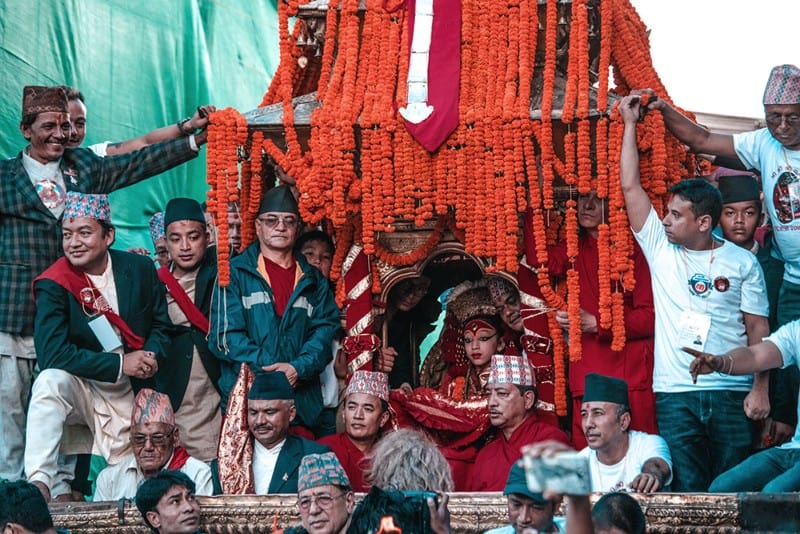
Indra Jatra is a colourful street festival held each year in Kathmandu, in honour of the Hindu god Indra. The celebrations consist of two events: Indra Jatra with its masked dances of deities and demons, and Kumari Jatra, which is a chariot procession for the living goddess Kumari.
Centred around Kathmandu Durbar Square, the celebrations last for eight days. This is also a time for family members who have died during the past year to be remembered.
Dashain (2026 – October 17-23)
Dashain is the most important Nepalese festival and stretches over 2 weeks with various stages and events. It is a celebration of good prevailing over evil, and most families offer male goats, ducks, chickens, eggs, and coconuts to the goddess Durga.
Many Nepali people return to their home villages at this time to spend the fifteen-day festival with their families. Large swings are set up for children, and from the tenth day, family members receive Tika (rice, red vermilion, and yoghurt) on their foreheads from their elders.
Tihar (2026 – November 7-11)
Tihar is Nepal’s second most important festival, after Dashain. In each of the three days, a different deity is worshipped: on the first day, the crow, the messenger of Yama and the bringer of death; on the second, dogs, which are believed to be Yama’s custodians; and on the third, the goddess Lakshmi, the bringer of wealth. Lakshmi is worshipped by lighting houses with oil lamps, candles, and colourful lights.
Chhath (2026 – November 15)
Chhath is the most important festival observed in the Terai region and falls on the seventh day after Tihar. Devotees fast and make offerings to the sun by gathering at river banks. The festival is dedicated to the Hindu solar deity, Surya, and the goddess Shashthi.
The Terai region is the best place to observe this festival, or the Rani Pokhari tank in central Kathmandu.
Want to experience Nepal’s unique culture and spectacular landscapes for yourself?
Nepalese Food is truly at the heart of Nepali life and culture. In this article, Aayusha Prasain, CEO of Community Homestay Network, explores the regional cuisine found around Nepal and discovers its origins, as well as the roles it plays in community life.
Food can be a vehicle for social change. It brings people together in a way that a very few other activities can.
Since my parents loved traveling, I had the great opportunity to travel around and try foods from different communities. Even back home, our kitchen was a melting pot of different cuisines, food was extremely important, and at a very young age gave me a chance to understand different cultures and helped me reflect on my own. I truly feel food is a powerful way to explore local communities, how people live, who they are, and how they see themselves.
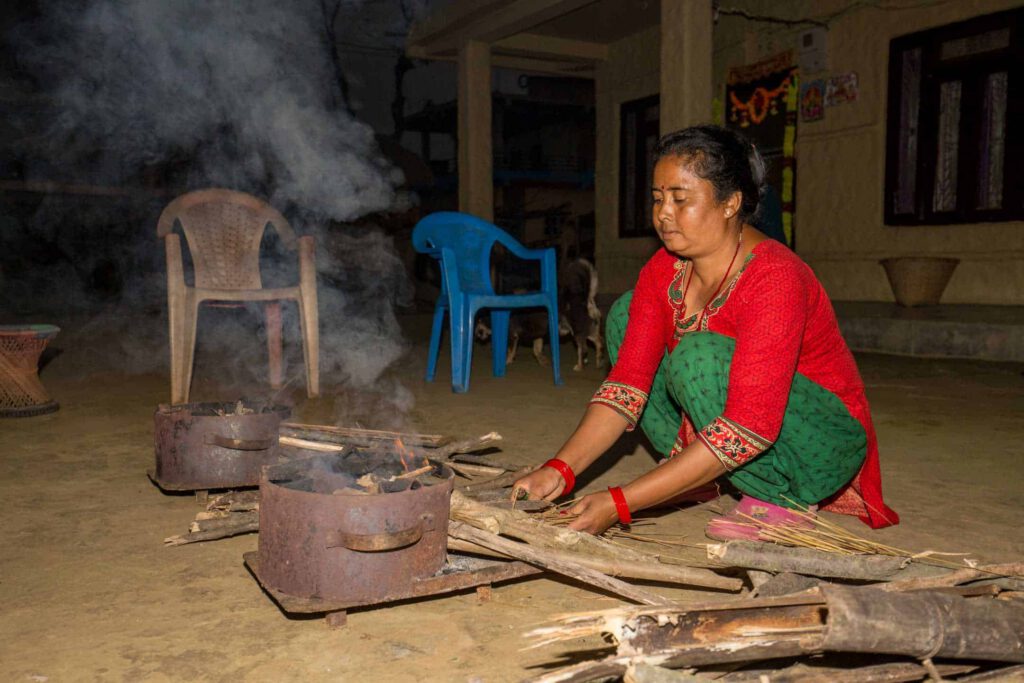
Preparing the fire at Barauli Community Homestay
Similar to the geographic and ethnic diversity, Nepalese food represents its unique culture, tradition, and lifestyle. The way people grow their produce and use it in their food shows their deep-rooted history, intercultural influences, and geographical diversity. Nepalese food is a melting pot of Khas, Himalayan, Trans-Himalayan, and Terai cuisines. Dal-Bhat-Tarkari, Momos, Thakali khana set, and Samay baji are some foods that represent Nepal in the international community. Not just the international community, but even in cities like Kathmandu and Pokhara, we have limited ideas about the range of Nepalese food.
Like many others, if I had not had the opportunity to travel, I would not have had the chance to broaden my perspective about Nepal, our culture, and food diversity. Traveling and living in different communities have made me realize that culture often refers to the characteristics that are formed through language, history, geography, and most importantly, food. I firmly believe that food mirrors local communities, their culture, and their tradition.
‘Wachipa’
One of the things I love the most while exploring new places is eating the local cuisine. Be it delicious Pork Curry in Dalla, Bardiya, or Wachipa in Phalelung, Panchthar, it always helped me understand and feel connected to the local communities. Often, we say that we know ourselves while exploring other cultures, as it gives us time to reflect and understand ourselves. Food is the perfect window for understanding different cultures and communities. With my direct engagement with communities through my work at Community Homestay Network, I feel fortunate to travel and enjoy the authentic dishes prepared by local communities. There is no better way to enjoy living locally and try local food than via a community homestay, where the host prepares each meal with the utmost love.
I found out that, traditionally, a lot of the food that I ate during my travels used to be prepared during the festivities; now the locals prepare it to welcome travelers to their community. With each meal that I enjoyed in local communities, I got closer to understanding their history and the cultural importance attached to it. Although it was not Maghi, the biggest festival of the Tharu people, it did not hold the hosts at Bardia Community Homestay still prepared the delicious pork curry. Hands down, that is one of the best pork curries I’ve had in my life. I am not a food expert, but I could not stop myself from having a second serving when it was served with rice for lunch.
Similar to French Escargot, Ghonghi is another popular dish among the Tharu Communities; knowing it is their specialty, I wanted to try some of it. As it is not very popular in Kathmandu, I did not want to miss the authentic taste while I was in Bardiya. The little Tharu Escargots were good beyond my expectations (it might not be everyone’s cup of tea, but it’s worth a try). The way it is prepared might vary within the Tharu community itself. Trying it out made me happy and helped me understand how geography and soil play a huge part in defining food habits and lifestyles. As the Tharu community resides near marshlands, rivers, and flooded plains, their cuisine is defined by various types of freshwater fish, crabs, and snails, among others.
‘Ghoghi’
Along with Bardiya, I had the opportunity to visit another Tharu community in central Nepal and live in Barauli Community Homestay, where I enjoyed fish and duck curry, which was locally sourced and prepared most authentically. I can not emphasize enough how different, in a good way, it feels to enjoy the food that is locally prepared.
Preparing the fire at Barauli Community Homestay
While exploring the eastern part of Nepal, Dobato, Ilam, is one of the least beaten paths I have ever been on. In collaboration with ICIMOD, the Red Panda Network had initiated a community homestay program to support eco-tourism in this area. Although a small community of 11 secluded households in the middle of the hills, it is rich in flora and fauna, culture, and tradition. The homestay I lived in was owned and run by an old Sherpa couple. The rich flavors of Thenthuk, the noodle soup, were incomparable to any I had had to date. I had had Thenkthuk many times before in Kathmandu. Apart from the organic produce and chilly weather, the love and warmth Syanghe Buwa (hausarbeit schreiben lassen) put in while preparing must have made it even more special.
‘Thenthuk’
As Nepalese culture and food are gaining more global exposure, recently, I was watching the UK’s BBC MasterChef: The Professionals Rematch, as one of the contestants, Santosh Shah, was from Nepal. Known for his innovative ways to present Nepalese food, I thoroughly enjoyed watching him on the show. Santosh Shah was later declared the winner. During one of the episodes, he prepared the dish with burnt chicken feathers, and I really loved the amount of research he had put into making his dishes authentic and representing Nepal beyond the foods that are already famous.
‘Tongba’
I was even happier when I had the chance to try the authentic Wachipa (the food Santosh was inspired by) in Phalelung, Panchthar, the eastern part of Nepal. I was there for a work visit and had an opportunity to explore the local areas and the most beautiful rangelands for yaks.
However, Wachipa and Tongba stole my heart. Wachipa is a dish originating from the Nepalese Kirat Rai people. The traditional side-dish, a combination of rice, minced chicken, and a powder that’s made from burnt chicken feathers, made a perfect combination for Tongba, a fermented millet drink. Some might not like Wachipa as it has a mild bitterness, but I loved the taste and the robust flavor that comes with it.
Traveling to the east always makes me feel like I am home. Both of my parents were born and raised in eastern Nepal; it feels good to understand that part of Nepal more through my travel there. As I was served a simple Dat-Bhat-Tarkari with a pickle in one of the homestays in Mai Pokhari Community Homestay, Ilam, I reflected on how food and culture can travel between communities and ethnicities. The pickle I ate that day is called Chop Achar, a simple achar made of oily seeds. Even though I belong to the Brahmin community, this achar (one of the traditional foods of Rai and Limbus) is one of the staples at my home, and my friends love it as it is unique to the flavors that Kathmandu or other parts of Nepal offer. I felt happy to reconnect with the roots and understand why it was a staple in my household.
As my mother was born and raised in Taplejung, a place where most people live there are Limbu, the way my mother prepares food is influenced and inspired by them. Due to the cold and mountainous terrain, it must have been difficult for people living there to prepare a fresh pickle every day. Hence, chop achar was made and might have become popular in the eastern Himalayan region, as it could be stored for up to a few months.
Whether traveling around Nepal or a person trying to make Bara, a Newari lentil pancake that holds significant importance in Newari Culture, at home in Kathmandu, I believe food can help you expand your horizons in understanding other cultures and roots while appreciating your own. Had I not had the chance to travel and make friends with people from different communities, I would have missed learning so much about Nepal and, most importantly, missed the opportunity to understand Nepal’s rich culture and flavors.
Ayusha Prasain is CEO of Community Homestay Network, a pioneering Nepali company who bring tourism to remote communities throughout Nepal. To find out more about the work they do and the unique experiences they offer to tourists, visit their site or contact our team for advice.
You’ll never really know a country until you know its food, and for many people, it is one of the highlights of experiencing Nepali culture. The average person spends almost 6% of their entire life eating Nepalese food and drinking, and the percentage probably increases on vacation, so it’s important to be prepared!
What do Nepalis eat?
The staple Nepali meal is the famous Dal Bhat, made up of dal (lentil soup), bhat (boiled rice), and tarkari (curried vegetables), usually served with achar (pickle) or chillies and a roti. Curried meats are also a popular accompaniment. You’ll find huge variations in flavour across the different regions and ethnic groups, such as Thakali and Newari cuisines, but it’ll always be tasty and plentiful.
Nepali cuisine has been noticeably influenced by neighbouring India and Tibet, and whilst the Indian connection is obvious, you may not know that Tibet gave us the Momo! Usually eaten as a snack or lunchtime meal, these fried or steamed dumplings are incredibly popular and come with all kinds of fillings. You can also enjoy Momo Cha, a Nepali speciality of momos in a spicy soup. You shouldn’t leave Nepal without trying one (or twenty!).
Regional dishes?
As you travel around Nepal, you’ll find unique dishes and cooking techniques that have evolved over centuries. You’ll find delicious soups, tasty meat dishes, and fresh fish curries across Nepal’s diverse regions, whilst Himalayan communities are famed for noodles, butter tea, and yak cheese.
Is Nepal good for vegetarians and vegans?
Very much so, in fact, the majority of Nepali cuisine is vegetarian or vegan. Meat dishes are easily avoided.
What if I don’t like curry?
Nepalese cuisine has undergone a food revolution in recent years, and in Kathmandu, you’ll find restaurants serving food from across the world. In rural areas, the options are more limited, of course, but Nepalis are very accommodating and will go out of their way to serve something that suits your tastes.
Do Nepalis drink alcohol?
Yes, alcohol has been a part of Nepalese culture for centuries, primarily taken during celebrations and ceremonies. The most common spirit you’ll come across is called Raksi, which is brewed in homes across the country and comes in wide varieties. Similar in taste to Japanese sake, it also packs quite a punch, so go easy!
Elsewhere, you’ll find local specialities such as Aila, Marpha Brandy and Khuhuri Rum, whilst during winter months you can enjoy a warm cup of Jhaikhatte, Tongba or Chhyang to help send you off to sleep.
If that all sounds a little heavy for you, then you can enjoy a nice cold beer instead. Everest, Nepal Ice, and Gorka are lager-style beers widely available throughout the country, whilst craft beer fans can try the microbrews made by Kathmandu’s Sherpa Brewery.
There’s also a growing wine scene, and although the local wines differ in taste from what you might be used to, they’re well worth trying. You’ll also find plenty of imported wines and beers throughout Nepal’s bars and restaurants, especially in tourist areas.
Is alcohol expensive?
As a general rule, alcohol is quite reasonably priced in Nepal. You should expect to pay the equivalent of about 2-3 USD for a local beer, but this might be more in some tourist areas. If you’re brave enough to try some of the local spirits, then you’ll find that these are surprisingly cheap (and your hosts will often offer you some free of charge!).
Of course, anything imported from abroad comes at a higher cost.
Is the water safe to drink?
We don’t generally recommend drinking tap water in Nepal, so it’s a good idea to bring purification tablets and a refillable bottle with you. Most good hotels will provide purified water for you to top up your supply.
Bottled water is relatively inexpensive and widely available, but of course, this isn’t great for our environment, so please refill if you can.
One of the biggest joys of travel is experiencing a different culture, but it’s always a good idea to have some idea of what to expect before you head off. As with most countries, Nepal has its own unique customs and ways of behaving, some of which might seem strange to you at first. Immersing yourself in the beautiful complexities of Nepali culture, language, and religion is the absolute highlight of any trip to this welcoming Himalayan nation.
Whilst Nepalis are unlikely to take offence to a minor faux pas, they’ll always appreciate when someone makes the effort to understand and respect their way of life.
What language is spoken in Nepal?
The national language is Nepalese, and all Nepalis can communicate with each other using this language. However, there are actually over 120 different languages spoken in Nepal, covering various regions, communities, and ethnic groups.
Do people speak English in Nepal?
English is the most commonly spoken international language in Nepal, and you’ll find that many younger Nepalis or those working in tourism will speak excellent English.
Amongst older generations and some rural communities, English is less common, and you may have to rely on smiles and hand gestures to communicate.
A nice smile will get you a long way in Nepal!
What is the religion of Nepal?
The majority of people in Nepal are Hindus, but Buddhism is also followed and has an important place in the country’s history and culture. Hinduism and Buddhism are closely connected, and it would take a lifetime to fully understand the complexities of Nepal’s religious life.
There are also minority groups who follow Islam, Kiratism, Sikhism, and Christianity in parts of the country.
Visiting temples and stupas
Religion is an integral part of Nepalese life, and you’ll see temples, shrines, and sacred artwork almost everywhere you go. You should show respect for the rules of their faith, especially when visiting temples and stupas.
Some sites may be prohibited for non-Hindus
Shoes should be removed at most temples and stupas
It is better to dress modestly and not show too much when visiting religious sites. Bare shoulders, backs, or midriffs will not be appreciated, and sleeveless tops, short skirts, and small shorts or pants are also likely to offend.
You should walk around clockwise when visiting temples or stupas
Don’t touch people or offerings on their way to a shrine
Cows are sacred in Nepal, so you should leave any leather products at home
Cultural Differences
From basic table manners to meeting and greeting people, every culture has its own quirks. Here are a few things to look out for;
If somebody says “Namaste” to you, you should return the favour – it is used as a friendly greeting in Nepal.
Nepalese women don’t normally shake hands, so don’t be offended if your handshake is refused! Usually, they’ll greet people by pressing palms together in a prayer-like gesture.
Nepalese table manners are likely to be quite different from what you’re used to. Often, you’ll see people eating only with their hands (sometimes with great enthusiasm!)
Knives, forks, and spoons are provided for guests, and you’ll not offend by using them.
If you do want to join in and eat with your hands, make sure you use your right hand!! In Nepalese culture, your left hand is reserved for bathroom matters…
It can cause great offence if you offer Nepali food that has already been touched, even if only by your cutlery
It is considered rude to touch an adult Nepali’s head, as it is considered the most sacred part of the body
Conversely, feet are considered unclean, so you should avoid putting your feet up on tables and chairs and avoid pointing the soles of your shoes at anyone.
Staying out of trouble
Drug crimes carry heavy punishments in Nepal, so it’s best to avoid drugs altogether during your stay
Along with revealing clothes, public displays of affection are frowned upon in Nepal and will draw unwanted attention. Holding hands is very normal between Nepalese men, but less so between couples.
You’ll see stray dogs throughout Nepal. Most are friendly and mean no harm, but you should act confidently around them and avoid giving them food. They’ll probably follow you all the way home if you do!
Potholes are quite common in Nepalese roads and pavements, so watch your step, especially at night.
Sadly, you’ll come across many beggars in Nepal, and not all of them are honest. Please be wary of giving them anything, since it creates an unhelpful culture and could be a scam.
There are numerous homeless charities, such as ROKPA and Habitat, that do amazing work in our country. If you’d like to help, we’d recommend contributing to an organisation that’ll ensure that your money is wisely spent.